
[H]umanism has no final way of saying certain things are right and other things are wrong. For a humanist, the final thing which exists—that is, the impersonal universe—is neutral and silent about right and wrong, cruelty and non-cruelty. Humanism has no way to provide absolutes. Thus, as a consistent result of humanism’s position, humanism in private morals and political life is left with that which is arbitrary.
—Francis Schaeffer—
I would suggest that my identity has nothing to do with what is right or wrong.
—Ben Shapiro—
Key points: Only by recognizing and respecting truth as absolute, including conventional (or traditional) standards of right and wrong, can individuals and societies avoid becoming trapped in limbo ethically and morally. Further, individuals and societies who are trapped need to be confronted — respectfully confronted, but confronted nonetheless — about the perils resulting from their beliefs about personal freedom. Those who believe in absolute standards of right and wrong — especially Christians — not only have the information people need, but also the authority to share it. We need to share humbly, but also with clarity, boldness, and confidence. We need to remain on offense!

On December 9, 2020, commentator and blogger Matt Walsh posted a video on Facebook titled “Ben Shapiro Obliterates Every Pro-Abortion Argument.” The video showcases several different exchanges between Shapiro and members of some of his audiences, as well as clips from Shapiro’s presentations on his news outlet, Daily Wire. Released by Daily Wire, the recording also is available on You Tube. I’ve placed it as well on this Word Foundations page. While the complete video is informative, it is the very first exchange I would like to highlight in this post.
Questioner: How do you defend your opinion as a white, well-off, religious man…how do you defend your — like, telling a woman what she can do with her body, and…

Shapiro: Because evil things are still evil, even if I’m a white, well-off, religious man. And good things are so good, even if I’m a white, well-off, religious man. This is one of these identity politics points that really, I mean, I don’t mean to come down harshly on you; I don’t. But it is a point that I have serious moral qualms with. I think it’s quite, quite terrible. The reason being, that the people who were fighting against enslavement of black people were a bunch of well off, white men, for the most part. Right? And those people were saying, “This is a moral sin. This is a moral blot.” They weren’t living in the South; they didn’t own plantations. They didn’t live the lives of the plantation owners. They said, “This is evil, and we are here to stop it. Right?
When you see something that you think is morally wrong happening, especially when you’re talking about the taking of a human life —
Like, listen. I think that, I think that you shouldn’t go around randomly killing homeless people. I just have this view. I’m not a homeless person. Most of the people who randomly kill homeless people are probably not of my economic strata, my religious view, or, I don’t know whether they’re of my skin color or not. I have no idea what the actual sociological breakdown of homeless killer serial murderers is. But I would suggest that my identity has nothing to do with what is right or wrong.

And this is what Western Civilization used to be about. Western Civilization used to be about the idea that, yes, I’m not a woman in the healthcare field. But you and I can have a conversation about right and wrong because this is the nature of human reason. The nature of human reason, the nature of right and wrong, is that you and I can talk about right and wrong, and that I don’t retreat into my identity.
If we can all retreat into our identity and if our morality is now centered around that identity, morality doesn’t exist at all. We break down into a society of fragmented atoms, where I can’t even say — like, you’re torturing a puppy in your backyard? I have nothing to say about that; I’m not a white woman who’s in the healthcare field.
I’m not going to do that. I refuse to surrender the idea that I can have a moral stance on issues that are of concern to society and of concern to the well-being to the United States, simply because of the color of my skin or the nature of my genitalia. And honestly, I believe that any of you that feels differently is sexist, racist and bigoted.
The Irony — And the Hypocrisy

Abundantly clear is the reality that leftists and those who have been duped by leftist lies contend that if you’re not
-
-
- a woman, or
- a woman of color, or
- a poor woman, or
- a poor woman of color,
-
and have a pro-life view, you’re a racist, a sexist, and bigoted. They therefore seek to disqualify you, not only from expressing your opinion on abortion, but also, even more fundamentally, from even holding the opinion you hold.
Here’s How to Uphold Absolute Truth
Providing a bold example for everyone who believes in an absolute standard of right and wrong, Ben Shapiro stays on offense. In the process he
-
-
- remains respectful,
- refuses to water down the seriousness of the issue,
- is not intimidated but remains confident,
- rejects and exposes the weaknesses of subjectivism and relativism, and
- credibly appeals to an external set of values that applies to all people and remains fixed.
-
The Benefits of Recognizing Absolute Truth
While many people today see absolute truth as overly confining and restrictive, ordered liberty is not possible without such a recognition. Let’s start with the absolute values inherent in the Ten Commandments. As we said earlier in a Word Foundations article,

How is it that following God’s law gives a person freedom? Consider this. As Christians, we tend to think of the Ten Commandments as being a set of laws that we as individuals are obligated to obey, and certainly they are, for each one of us is accountable to the God who gave His laws to us. Having come from God, His commands “are absolute,” writes Dennis Prager. They “stand in direct opposition to all relativistic approaches to morality — the notion that each individual or society determines what is right or wrong.”1
It is a commendable thing when one person obeys the laws of God, but think carefully how liberating it is on a corporate or national level when a society revers and obeys them. Let’s think first about this in relation to the last five of the Ten Commandments. If my neighbor will
-
-
-
- obey the Sixth Commandment and refrain from killing me,
- obey the Seventh Commandment and respect my marriage relationship to my wife,
- obey the Eighth Commandment and not steal from me or my family,
- obey the Ninth Commandment and not lie about me, and
- obey the Tenth Commandment and not inappropriately desire what isn’t his, then
-
-
my rights to life, security in my marriage, property, a decent reputation (assuming I have earned it), and respect for my ownership of what belongs to me — all these rights — are protected, at least as far as my relationship with my neighbor is concerned.
Now, suppose all the members of my neighborhood respect and obey these commands. Suppose the citizens of the larger community do. Aren’t all of us freer and safer because of the mutual respect we have for one another’s rights — and the reverence we have for God?
Yet,

If there is no absolute moral standard, then one cannot say in a final sense that anything is right or wrong. By absolute we mean that which always applies, that which provides a final or ultimate standard. There must be an absolute if there are to be real values. If there is no absolute beyond man’s ideas, then there is no final appeal to judge between individuals and groups whose moral judgments conflict. We are merely left with conflicting opinions.
A Rejection of God

You show me a society that has rejected absolute truth, and I’ll show you one that has rejected God. Both absolute truth and God are external authorities, even though through His law, God expresses His own character.
Twice in the Book of Judges we read, “In those days there was no king [or authority] in Israel; everyone did what was right in his own eyes.” This is the current state of America. Proverbs 12:15 tells us this about that perspective: “The way of a fool is right in his own eyes, But he who heeds counsel is wise.” What are Christians to do in such a society? I offer the following five insights.
First, we must realize that societies that reject absolute truth are vulnerable to tyranny. Let us heed the words of our second president, John Adams, who, in a letter to his cousin Zabdiel Adams dated June 21. 1776, wrote

Statesmen my dear Sir, may plan and speculate for Liberty, but it is Religion and Morality alone, which can establish the Principles upon which Freedom can securely stand.…The only foundation of a free Constitution, is pure Virtue, and if this cannot be inspired into our People, in a greater Measure, than they have it now, They may change their Rulers, and the forms of Government, but they will not obtain a lasting Liberty.—They will only exchange Tyrants and Tyrannies.
Second, we need to understand the power of relativism to elevate people’s identities, or their perceived identities, to a place of authority in people’s minds. Listen again to the exchange between Ben Shapiro and the young woman who asked him a question. She not only appealed to her identity as a woman (and to every woman’s identity), but also to Shapiro’s identity as a “white, well-off, religious man.” Her assumption was clear — Shapiro’s identity disqualified him from the debate over abortion.
Here’s another example: “Over time, the definition of homosexuality has shifted from being a behavior to a condition to an identity.” Believing their identity to be definitive, those who practice homosexuality have difficulty divorcing their decisions and choices from what they believe about who they are. This is not to say that they make their choices without being influenced by desires and temptations, but it is to say that seeing their homosexuality as primarily a behavior will help to free them from the assumption that who they are will dictate their behavior.
Third, we must realize that in a society that has rejected absolutes, people will be offended when they are confronted with the idea that what they believe or what they are doing is wrong. Please note, we are not talking here about liking football over baseball, or popcorn over tortilla chips. These are personal preferences that are inherently unique to individuals. We are talking about the idea that moral and ethical standards exist objectively and externally, and that they apply to all people, everywhere, under all circumstances.
Ohhhh! In a society that has embraced relativism, people hate this idea! Even many who never have embraced relativism find the gospel offensive because it stresses the truth that all people have broken God’s law and therefore are sinners. Let’s put it another way. It is the nature of the gospel to be offensive, because people inherently do not like to be told that “what you are doing is wrong” or that “you are a sinner.” This is the unpleasant aspect of the burden Christians carry because of their recognition of absolute truth. It is the gospel’s “bad news.” However, ultimately there is good news, if we are willing to receive it.

While absolute truth informs people that the moral “truth” they’ve made up for themselves is counterfeit “truth,” it also has the potential to liberate. When we cooperate with God and approach Him on His terms, or when we resolve to cooperate with the realities that are self-evident in moral and ethical realms — these constitute paths to personal salvation and ordered liberty in society.
Fourth, the need to appeal to and uphold absolute truth is great. Much is at stake! Individual citizens and our nation as a whole are being held captive to lies, and they need to hear the truth. As we have affirmed, upholding absolute truth in a relativistic society will
-
-
- offend and threaten those who wish to receive legitimacy for their own lawless actions, and it will
- anger the elites in positions of power who are attempting to impose arbitrary absolutes on society.
-
However, people desperately need to know about their need of a Savior, lest they fail to repent and receive salvation. Further, on the national front,
If we as Christians do not speak out as authoritarian governments grow from within or come from outside, eventually we or our children will be the enemy of society and the state. No truly authoritarian government can tolerate those who have a real absolute by which to judge its arbitrary absolutes and who speak out and act upon that absolute. This was the issue with the early church in regard to the Roman Empire, and though the specific issue will in all probability take a different form than Caesar-worship, the basic issue of having an absolute by which to judge the state and society will be the same.
To make no decision in regard to the growth of authoritarian government is already a decision for it.
—Francis Schaeffer—
Here is a sentence to memorize: To make no decision in regard to the growth of authoritarian government is already a decision for it.
Fifth, anyone with an understanding of the nature of reality in moral and ethical realms — anyone with an understanding of the nature of truth — can advocate for absolute truth. You don’t have to be a “white, well-off, religious man,” but you certainly can be one, as Ben Shapiro is, and contend for absolute truth.
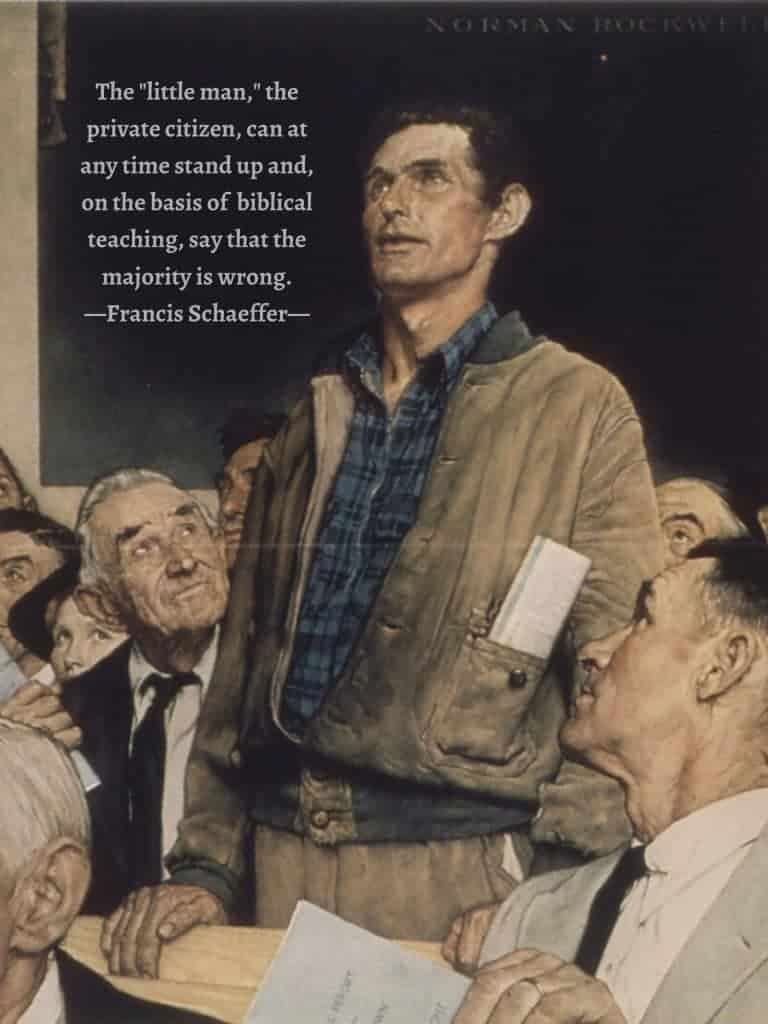
Christians especially have a responsibility to do so. We don’t just have the information people need to hear; we also have God-given authority to share it. Accordingly, Francis Schaeffer observes, “The ‘little man,’ the private citizen, can at any time stand up and, on the basis of biblical teaching, say that the majority [or the elite] is wrong.”
Do you realize how revolutionary this idea is? Reality isn’t Rex Lex — the king is law, but, as Samuel Rutherford put it, Lex Rex — the law is king. In other words, no one legitimately is a law unto himself.
Further, do you understand what a privilege it is to contend for the truth in a world full of lies? Nothing is as liberating as this! Nothing! Yes, there are risks, and yes, there are costs; but there also are rewards. Jesus said, “[Y]ou shall know the truth, and the truth shall make you free.” Pointing people to the way of truth means pointing them to the way of authentic freedom.
Let’s Review
How are Christians to respond in a world where relativism has taken hold? Though not a Christian, Ben Shapiro demonstrates for us to a large extent what we need to do. Here are some important points to remember.
-
-
- We must realize that societies that reject absolute truth are vulnerable to tyranny.
- We need to understand the power of relativism to elevate people’s identities, or their perceived identities, to a place of authority in people’s minds.
- We must realize that in a society that has rejected absolutes, people will be offended when they are confronted with the idea that what they believe or what they are doing is wrong.
- The need to appeal to and uphold absolute truth is great.
- Anyone with an understanding of the nature of reality in moral and ethical realms — anyone with an understanding of the nature of truth — can advocate for absolute truth. Accordingly, Francis Schaeffer observes, “The ‘little man,’ the private citizen, can at any time stand up and, on the basis of biblical teaching, say that the majority [or the elite] is wrong.”
-
You hold the keys to authentic freedom and liberty. Will you seek to use them, or will you merely hold onto them?
Don’t waste your opportunities! Use them to help others and society at large!
Copyright © 2022 by B. Nathaniel Sullivan. All rights reserved.
Related: a Word Foundations series of articles: Contending for the Recognition of Absolutes
Unless otherwise indicated, Scripture has been taken from the New King James Version®. Copyright © 1982 by Thomas Nelson, Inc. Used by permission. All rights reserved.
Note:
1Dennis Prager, Exodus: God, Slavery, and Freedom — The Rational Bible, (Washington, DC: Regnery Faith, 2018), 220, 221.
top image credit: Photo by Kenny Eliason on Unsplash


Great job Bev! Well done…
Thank you, Oscar!
[…] the article I released immediately prior to this one at Word Foundations, I […]